


Why I like a pair of dice in Mint Tin Pirates
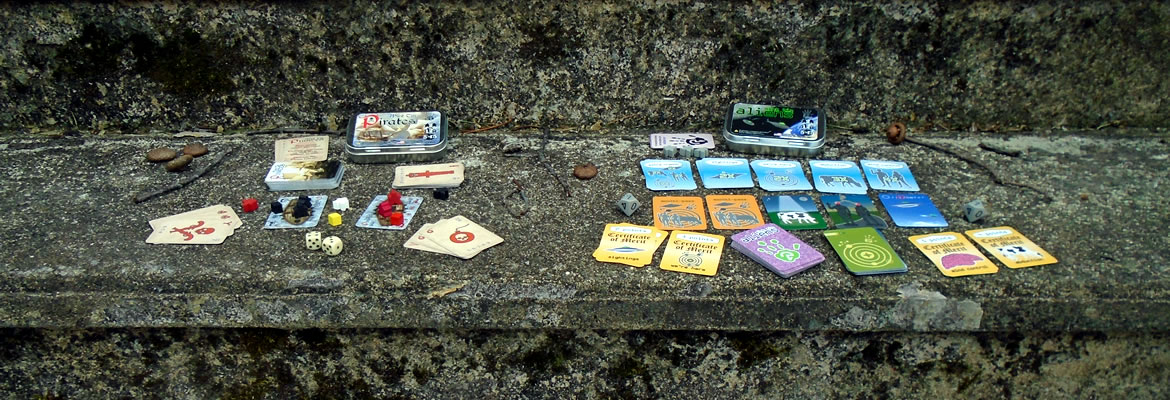
When Steve and I decided to do a challenge of creating mint tin pirate games, the only guidelines were that they fit in a mint tin and be playable in 10 minutes or less.
We’ve both play tested the games and will be bringing them to a game design meetup tonight.
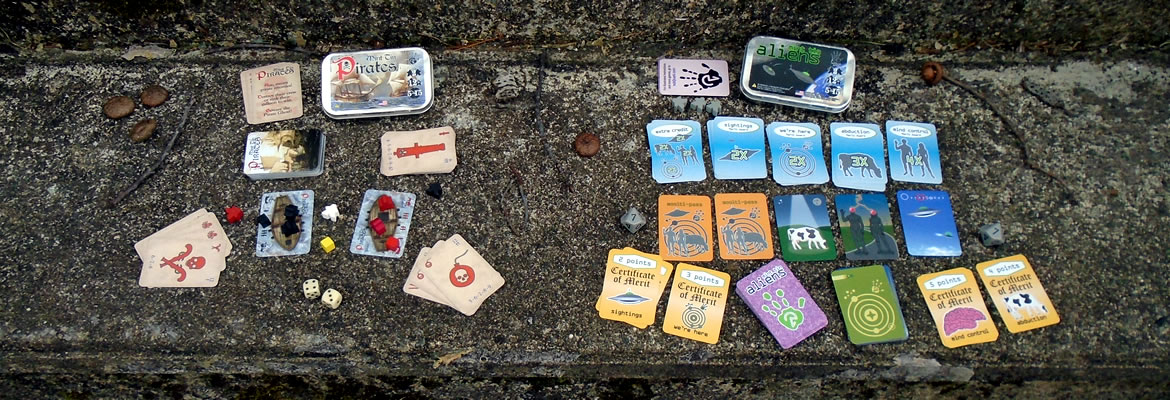
Both have mini cards and mini Meeples, but that’s where the similarity ends.
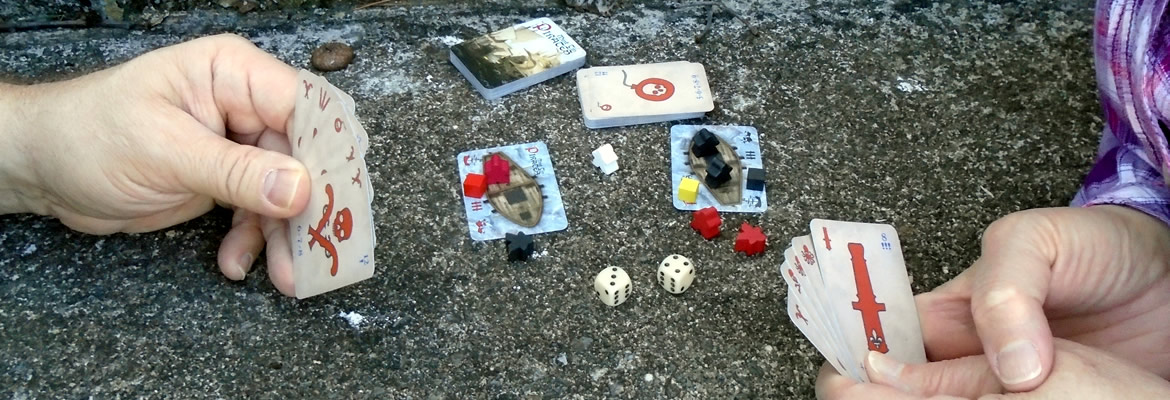
Steve’s is hand-to-hand combat (literally). Both players throw down an attack simultaneously. If they are tied, they can each add to their attack. Two swords against two swords can be won by throwing down another sword or adding a pair of cannons. It’s fun and fast paced.
His game makes it feel like you’re dueling and can defend yourself – it fits the pirate meme.
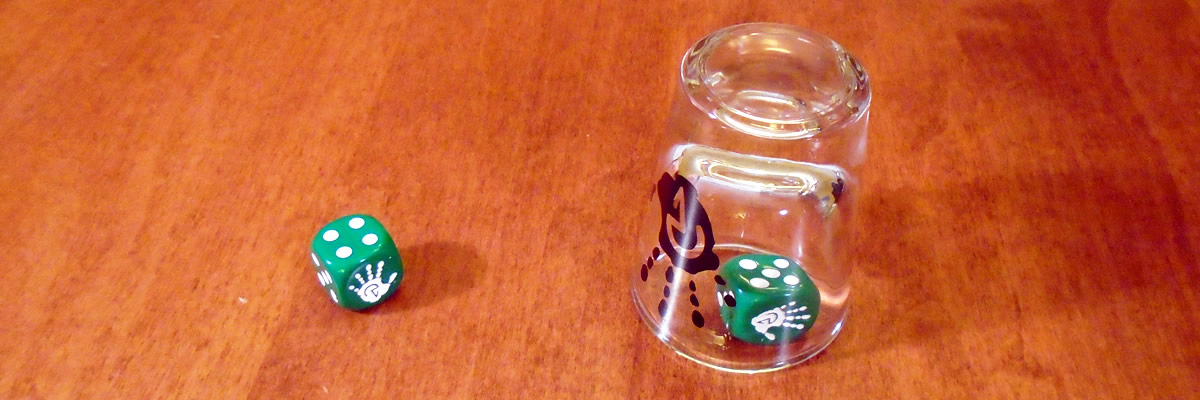
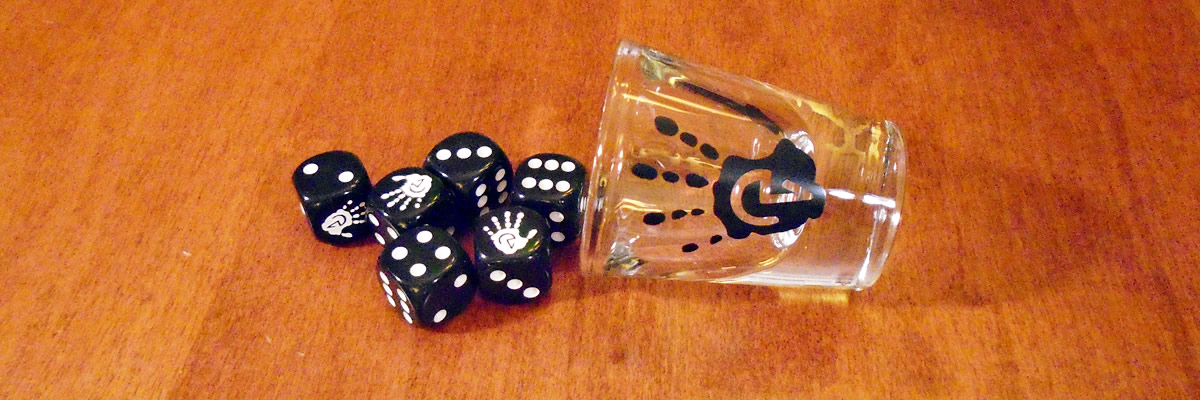
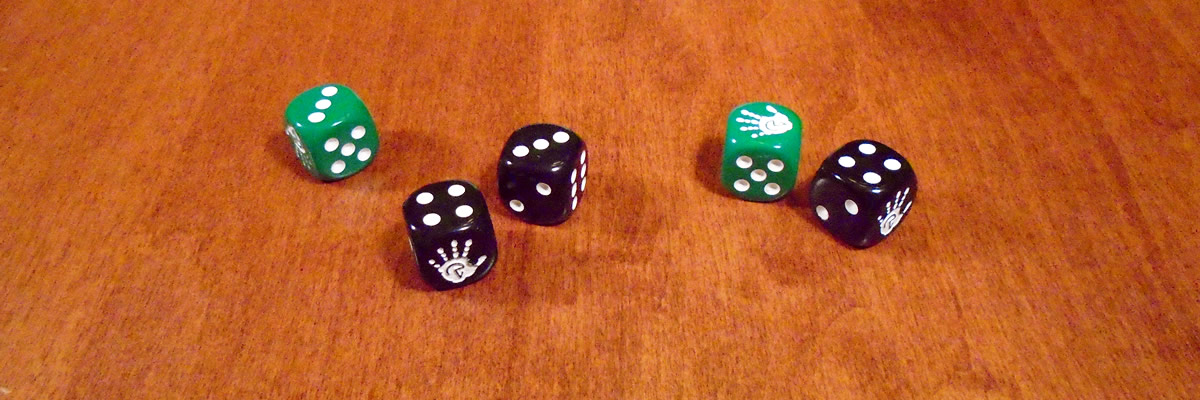
With my version, players take turns and attack only with pairs. You roll two dice to see if your attack is successful. In my mind, a cannon could miss the opponent when the ship rocks in a wave, a knife throw could also miss or the targeted pirate could duck, and a swinging swashbuckler on a rope could totally miss. The dice act as those random factors.
The game could be played with a single d6 dice and it would save on the cost of the game but here’s why I like a pair of dice:
A pair of dice seem more fair.
Here’s the probability for each number with a single six sided dice:

And here’s a pair of dice:

The single dice has the same probability for every number in every roll and the pair of dice has a classic bell curve for it’s probabilities – some outcomes are more likely than others – rolling a 7 has the highest probability.
In Mint Tin Pirates, the 5 minute game uses a roll of 5, 6, 7, 8, or 9 as a successful attack. Statistically, that means you have a 66.7% chance of winning each throw.
But you can also have a 66.7% chance of winning with a single dice if you say that a roll of 3, 4, 5, or 6 is a successful attack.
So if you have the same percentage for success with one dice versus two dice, why use two?
It’s all about what feels more “right”.
That sense of feeling right is important for a game to be fun to play. You have to feel that you have a chance to win (thus Las Vegas – the casinos win more than they lose, but despite this being obvious with their fancy hotels, extravagant fountains, and cheap food and drinks, people still love to gamble).
The bell curve of a pair of dice makes it feels like you have more chances to win even though the probability can be the same with a single dice. The number of combinations, 36, makes it feel more exciting than just the 1 in 6 of a single dice.
So, that’s why I like two dice. =)
charts from AnyDice – an easy to use online dice probability calculator
Game POD vs. Book POD
I’m new to game design and that’s what some of these blog posts are – my journey in becoming a “publisher”.
What’s that mean anyway?
Publishing, in my simple terms, is about putting out something in a way that others can use.
Books are easy to understand – a book’s written, printed, and distributed. Today, many books are distributed digitally (with Amazon Kindle Express upload a Word or Open Office document and it’s available to the world within 48 hours).
Publishing also covers songs, software (like our Sim-on-a-Stick), online games, apps, and many non-printed forms of media.
If you blog, heck even if you tweet, you’re publishing your work to share with others.
Print on demand (POD) for paperback books is nearly identical to printing with a “real” publisher like Penguin or Bloomsbury. Lightning Source is the largest book printer in the US and they are the exact same quality as the majority of real books from real publishers (because they print their books too). o_O
And the cost is low – a 106 page book is $2.52.
You can set up a book title for about $79 with Lightning Source (file submission and proof fees) and it’s available to every brick and mortar store in the US plus Amazon and Barnes & Noble.
Setting up a book in Amazon is even cheaper – about $35 – and it will be listed at Barnes & Noble too. Brick and mortar stores don’t like writing checks to their biggest competitor, so unless your book is a huge hit, you’ll never see it on a store bookshelf (that’s another post).
Game Publishing – is it as easy as books?
Nope.
There are very few places that act in a similar way to Lightning Source and Amazon. The Game Crafter is one such example. You can publish your game via them and they can print single copies of it. The cost is reasonable considering their volume (they aren’t an Amazon.com nor do they print 2 million a month like Lightning Source).
However, games don’t have a set format. Books have standard sizes and use ink on paper. Games can be many sizes and have custom components. With The Game Crafter, you’re limited to what they have available. There’s nothing wrong with that but it means that your POD game has to be partially defined by that constraint. I want to publish a game called ZOMBALAMBA but it has hex tiles larger than The Game Crafter carries so that’s not an option (plus custom dice too).
There isn’t a true POD solution for custom games. Not for single copies. And this doesn’t even start to consider shipping a game internationally and meeting consumer safety laws with potentially huge fines . . . =(
There are groups like Panda Game Manufacturing to make your game or Game Salute that can publish your game.
As a little guy, I can’t afford to pay for a minimum print run of 3 or 5 thousand games with Panda. And Game Salute has to approve your game, they are a gatekeeper much like publishing houses are (don’t you know that the publishers who turned away J. K. Rowling kick themselves daily!).
For now, truly independent game creators are either constrained with what components are available or have to source it all themselves (or have a decent amount of money up front – Kickstarter? that’s yet anther post!). =D
Fortunately, Maker Culture, or Kitchen Table Industrialism, is starting to support the small independent game designer.
That’ll be another post, the lessons I’m learning from designing Min Tin Pirates as a self-published and US-sourced game. Thanks for reading and please add your insight – all comments are welcomed. =)
