








Teaching Environmental Science in Virtual Worlds
As Enclave Harbour comes closer to completion, it is time to start sharing some of its objectives. Enclave Harbour has several goals and part of its mission statement includes raising environmental awareness.
This is done by including obvious “green” practices, such as a solar array farm and wind turbines, and subtle practices such as pitchered water and glasses versus bottled water for meetings. Ener is doing a wonderful job of building with a “green” attitude (and a thank you to DreamWalker for scripting those).
Including such elements in a virtual world setting does help keep environmental awareness in the forefront. However, we also go beyond simply incorporating such things to developing formal programmes to explore environmental science.
As a former middle and high school science teacher, then later a professor of college Geology and Environmental Science, coupled with a Bachelors in Physical Science (major Geology, minor Chemistry), I am enjoying developing virtual world facilitated educational activities.
While early in it’s development, several learning “tracks” are in the works. One geared toward middle school Earth Science, another to high school as a possible mentor programme, and perhaps a corporate track.
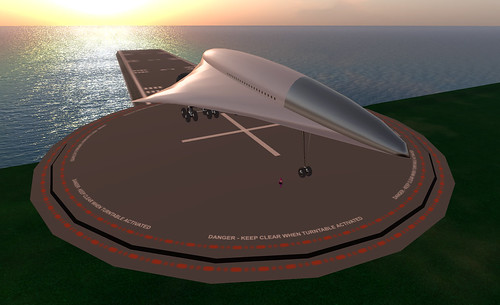
Let’s take a look at a quick example: a fantasy jet.
For middle school use, you can illustrate that hot exhaust gases cool in the atmosphere and create “contrails”, or condensation trails. You can refer to these as artificial clouds and tie into the water cycle as an example of condensation. You can also introduce the concept of carbon footprints, as well as aerodynamics, lift, and more. As a supplementary exercise, the sky is the limit (pardon the pun). =)
At the high school level, you can discuss adiabatic change, when a compressed gas expands and loses heat. This can lead to discussions on entropy, jet propulsion, environmental costs both in the air and on the ground (as in avian migratory patterns – interesting species such as the snowy owl of Boston’s Logan airport – and the real cost to airport administrators and travelers). Details such as adiabatic change, while not strictly tied to air pollution, are important in environmental science literacy. Apart from keeping air pollutants suspended, condensation trails have long been considered as climate factors.
The thought being that additional and perpetual “cloud” coverage from daily jet traffic both holds in some of Earth’s emissivity (the release of infrared energy from Earth’s surface – that energy having been imparted by the sun shining on our planet) and increases the reflection of the sun’s solar energy (albedo). This was thought to have been proven when data was collected in the three days that air traffic was suspended in the US after the attacks of 9/11. A difference in daily temperature fluctuation of 1 degree Celsius during those three days was attributed to contrails.
However, subsequent studies tend to point to natural factors affecting that change. This type of exploration is key to students learning to look at the world differently and understand that science is not separate from our lives, but rather a part of it. And to question science. After all, part of the scientific method is to be open minded – something science is actually somewhat poor at doing. It often takes years for science to make changes (Alfred Wegener proposed continental drift in 1912 yet it was not regarded as possible until the 1970s – I have a National Geographic atlas from 1968 touting the expanding Earth theory for the continental and oceanic plates).
You get the idea, this one “build” can be used in many ways and serves as a catalyst to expand beyond itself. From simple observations “why do planes leave white trails in the sky?” to term papers discussing any number of details.
Stay tuned for more information about Enclave Harbour in Reaction Grid!
this post also carried on the iliveisl blog
Connect the Social Networking Dots
Anyone with a Twitter account is a social networking ninja! Well, so it seems. Even Guy Kawasaki cringes at that! Of course, he is actually a social networking guru. However, simple practices can make big differences. I see many eLearning webinars on how to leverage your social efforts and drive more traffic.
In reality, it comes down to content. Just like in eLearning material. Good content shines, regardless of it’s packaging. I use the example of Plato drawing in sand to teach profound things. These things became timeless because of their value and pertinence to others. The same with your eLearning. If it helps someone do their job better and/or have a better quality of life, then you have done well.
Certainly, very poor execution of delivering your content can have a terrible affect. But I find that we often focus so heavily on the technology, that we sometimes place the content second. I see LinkedIn questions that make me shudder on this topic.
The same holds true with social networking. There are some things you can do, like connect your blog to LinkedIn and Facebook, connect Twitter to those two as well. Use a Flickr image in every blog post (my preference because Flickr is growing faster than Photobucket and since Yahoo owns it, it helps with SEO as does Photobucket).
None of these things are rocket science and blogs such as DoshDosh.com will help you select what is best for your particular goals.
As you likely know, I set up the accounts and wired them together for the former iliveisl Second Life estate. Now that has changed focus from Second Life to OpenSim hosts Reaction Grid. Much trial and error went into finding the right places to help broaden the reach of iliveisl. From CafePress to t-shirt affiliates to Facebook to Ning and so on. In the end, what worked for us, was a blog, flickr, and Twitter.
And the important thing? Content.
In the two years of blogging for the iliveisl estate, very few posts ever pushed land sales. Topics are predominantly the ramblings of an everyday avatar (and there are also 3 other authors, including me, who added a different perspective on more technical topics). The same for the iliveisl Twitter – casual conversations.
Many people think of Twitter as a sales tool and push their branding message like mad. Even Coca Cola has had poor Twitter results because of this. Granted, Dell has done very well, but they pass on very real savings via Twitter, not just hype about their product.
If you have good content that your audience enjoys, you will grow your influence. So try out this and that, give it time – if you are starting a Facebook fan page, be attentive to it, deliver useful information, and wait. It takes longer than you think to see results. At least in our case it did. Six solid months of blogging an average of 10 times a week yielded solid results for iliveisl.
Here are the results of that effort. Keep in mind that iliveisl is predominantly one person and a shoestring budget versus a 300 person company with a million customers (Second Life) and I added Reaction Grid in there because we want to see it grow and will do our small part to aid that.