





#facebookfail says boo to Ener Hax
Quite a stir in the twittersphere on yesterday’s news of Ener Hax’s account being disabled by Facebook. You may know that I am partial to Ener, after all, we are partners in virtual world endeavors.
Ener became the the clear “spokesperson” of our inbound marketing efforts. I think of her as the Erin of Esurance (both have pink hair) or as Danica Patrick of GoDaddy.com (both go around in circles fast). When I first started setting up the social networking accounts two years ago, everything was being set up as iLIVEisl (I live in simulator lands).
I simply followed the advice laid out by Maki of DoshDosh.com. Wonderful tips, links, and strategies to increase your web presence. From Cafepress and Busted Tees to Twitter and Facebook. It quickly became clear that Ener Hax had more traction than an abbreviated phrase.
Plus, as a pink haired and winged avatar, Ener Hax is easier to form a connection with. A few years back, Ener was content with only existing in Second Life. But as the internet presence grew, she embraced that aspect and grew it exponentially.
The “campaign” I was aiming for was to increase Second Life land sales of the iliveisl estate and promote the eLearning conferences I speak at. Using virtual worlds as an alternative to 3D animation applications (Blender 3, Maya, Studio 3D Max) is something I still practice and well received as a presentation.
However, the shutting down of her Facebook account ignited an interesting discussion of what it means to be an avatar.
Is Ener Hax, as a virtual identity, a real person?
There are very real assets tied to the name. The 12 sims in Second Life are, as well as all of the objects being created for our Reaction Grid endeavor.
There are real world items and business that belong to that virtual identity, to an avatar. Not only does Ener Hax make real money but the reputation associated with her is valuable. Ener Hax also does custom projects and deals 100% as an avatar in them.
Is the line blurring with identity? Or is an avatar simply an alias like a “doing business as” identity?
Facebook does allow avatars to have pages, but they have to be fan pages (which is what I wanted to initially set up – they do not have the 5,000 friend limit).
5,000 sounds like a lot, but over a six month period, Ener had 3,800 friends. 90% of which are avatars. Also, Linden Labs is looking to connect Facebook to Second Life. The decision to disable avatar accounts puts limits the value of integration.
I build as Subquark Hax in-world, not as David Miller. Subquark has a certain credibility level in virtual worlds and not many know my real world name, nor does it matter. There is less room to bs about your skills in virtual worlds. Either you can build and script or you can’t. A simple right-click on an in-world object will reveal its creator.
As my rockstar, Ener Hax has capitalized on this Facebook issue and turned it into positive press and deeper web reach (I am slightly biased, as you can tell). Her Twitter efforts were magnified in the past 24 hours and now she has a bonafide Facebook fan page.
Here is a passionately written sample of how the avatar community has commented on this: http://foo.secondlifeherald.com/slh/2010/01/is-facebook-killing-avatars-again.html
They would like to interview the once shy and quiet Ener Hax because of all of this. So unwittingly, Facebook seems to have done us a favour!
Rock on Ener Hax!
I particularly loved your tweets to M Linden last week asking him to have the courtesy to address you.

Green meetings in virtual worlds
You have seen our posts, here and on the iliveisl blog, about our new endeavor with Reaction Grid.
We are doing two things with our new grid: eLearning and meetings. For meetings, it gives you a private option for distance collaboration, immersive inclusion of remote employees, and an opportunity to leverage benefits that companies like IBM have discovered.
Our goal is to show you the value of your own grid. These are not “sims” as in Second Life. In Second Life, you have three options:
- buy your own sim,
- buy part of a sim, or
- use the new Second Life Enterprise solution.
The costs are USD$1000 to buy a sim and then $295 a month, lease part of a sim from someone like us at iliveisl, or pay $55,000 per year as the starting price for your own Second Life box.
For corporate eLearning and/or meetings, the ROI may be difficult to justify.
However, there are advantages to being part of the Second Life grid. You have access to tens of thousands of user-created items (this can make it challenging to find good ones – however, there is a Gold solution provider store you have access to, but Linden Lab collects a 30% commission on sales – meaning higher prices for corporate users).
On the other hand, with Reaction Grid, you can have your own grid, not sims within a grid. And it’s less than 25% the cost of Second Life, in some cases much less.
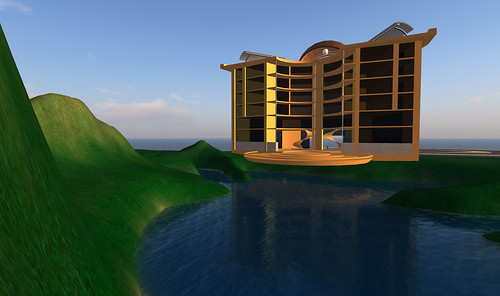
Intertwining of environmental awareness in our offerings is important. In our Energy Hotel and Conference Centre we showcase the latest in best practices for corporate social responsibilty. From pitchered water, to recycling receptacles in every room and we include outward links to practices you can incorporate into your real world events and meetings.
In the hospitality world, “green meetings” are becoming the norm. Here is a nice example of a page highlighting the green offerings of Kimpton Hotels. IHG has an interactive one that plays very well here.
Part of our offering is the ability to go a step further and create videos highlighting those same points (this leverages our eLearning practices of shooting video in virtual worlds). And to do so in an economical fashion.
The richness of a video combined with the “look” of a virtual world can mean a competitive advantage for your property’s website. In the IHG example, a drawing was used of a generic hotel and its green aspects were highlighted. You can expect to pay over $20,000 for a microsite like that; it is very well done.
In addition to showcasing your property’s green practices, you could offer a virtual supplement to your meeting packages. Similar to offering teleconferencing equipment or a Twitter board. This adds more value and advantage because it is you that is offering this supplemental venue, rather than what is happening in many markets now where a third-party is doing this.
Last year I spoke at a conference in Texas and was surprised that the hotel hosting the conference was not hosting the virtual element of the conference. Nor were they involved in the 2010 conference’s virtual component. This is easy offering and one that would be profitable. As a person working for a sales and catering software company, I understand the fear that virtual meetings will replace real meetings.
However, virtual meetings are here and you can either offer it to your clients as an upsell or someone else will. In Second Life, Virtualis charges about $7 to 8,000 for a three day virtual event. I have hosted daily meetings and charge similar rates. Why not add it as an offering? The key is to keep it simple.
We’ll write more and layout the pros and cons of offering virtual space like creating additional places for vendors to get their word out, thus increasing the strength of you RFP response. And also how to leverage it for inbound marketing purposes.
To get other views on businesses in OpenSim worlds, this blog is well written and very informative: Hypergrid Business