












3D virtual tour from Second Life
Here is Second Life being used to created a 3D virtual tour. This version is heavily compressed on blip.tv.
[blip.tv ?posts_id=2637140&dest=-1]
While Second Life does not have the detail of Blender 3D or Studio 3D Max, it has other advantages.
Your 3D space can be viewed and experienced by almost anyone, they just need to be able to run Second Life. There is no rendering time since it is captured live with a tool like Fraps and in using a free tool such as Windows Moviemaker or Mac iMovie, file sizes are much smaller than Blender 3D, Studio 3D Max, or even Google Sketchup. This acceptable quality 18 second clip is 3.61 MB, still rather large for 18 seconds of 640×480 video.
There is no doubt that the detail in other programs is higher, Second Life can not compete on this since it is rendered live. The quality difference is mainly in two areas: the total polygon count and shadows. Poly counts are what give fine detail, but they also can not be rendered live. This video was shot at 60 frames per second and Second Life was actually running at 110 frames per second. To “fake” shadows, transparent shadow prims were placed beneath objects. Light “cones” could have also been used to simulate beams of light cutting through smoky air.
To film in Second Life, a product called Filming Path was used. This tool has suffered from jerky camera action after Mono was introduced into Second Life as a far more efficient script engine. To offset that a little, this video was shot at 60 frames per second as mentioned above (try rendering that in other 3D apps, estimated time of upwards of 4 hours).
Take a look behind-the-scenes on how the set was laid out for this test in this Flickr set.
The power of Twitter and Facebook
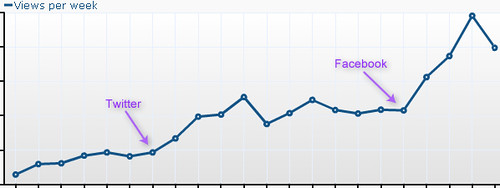
Here’s a graph pulled from the iliveisl blog‘s WordPress stats. It clearly demonstrates how an aggressive social networking campaign in Twitter and Facebook can affect traffic.
Interestingly, commenting on some topics are 20 deep, but on Facebook, not on the blog. Speaks to the hassle of identifying yourself on blogs in order to comment.
The blog automatically tweets out and Twitter automatically updates Facebook. That’s nice integration. =)