


Researching woodcut playing cards
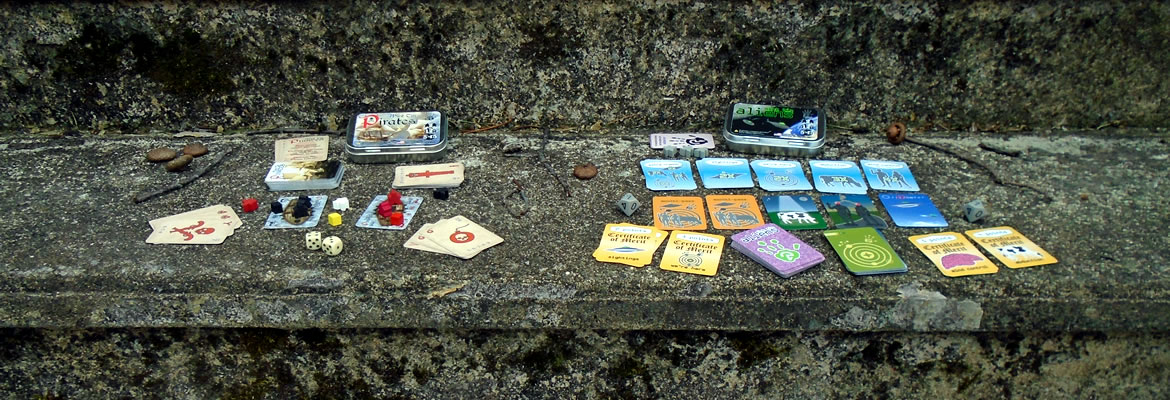
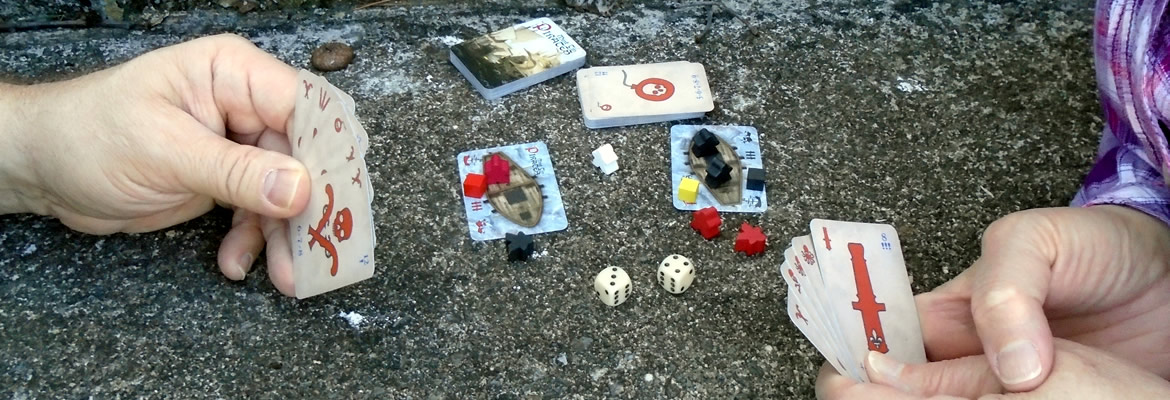
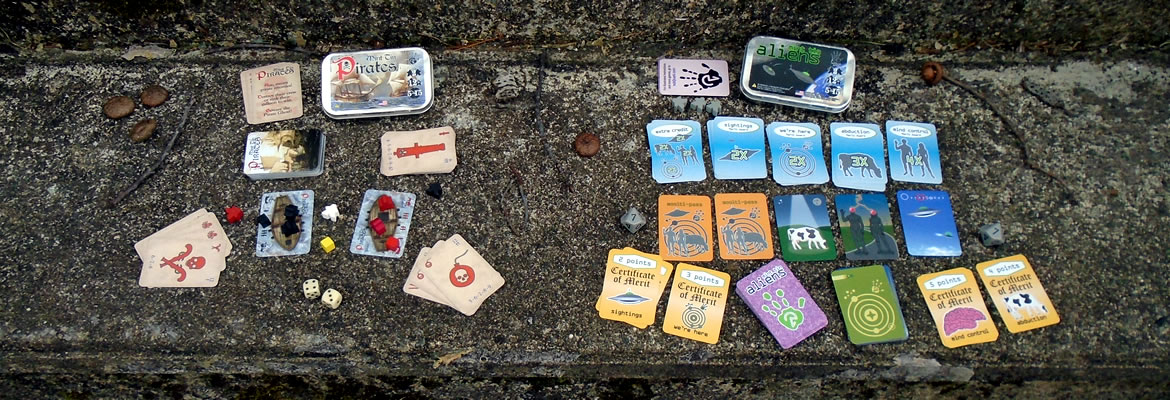
For Mint Tin Pirates and Mint Tin Knights, I’d like a late medieval woodcut printed style for the playing cards.
Woodcut printed cards probably came to Europe in the 1300s but had been in China and Japan since the 700s.
The medieval age ended in the 1400s but knights went beyond that and the earliest recorded piracy on the high seas was the 14th Century BC!
So far so good on the time period, but what about the weapons in these games?
Cannons, knives, crossbows, and maces were in existence before the 1400s. But I wondered about blackpowder pistols and grenades.
The first European handheld cannons were in the 1400s – essentially pistols (but not flintlock) – and the first cast iron hand bombs (grenades) appeared in Europe in 1467.
Why the historic fuss over a light casual filler game?
It’s purely a personal thing – I think being rooted in history adds a bit for some players.
Of course, having cards that can return a lost pirate as a Pirate Ghost or a dead knight as a Phantom Knight isn’t historically true, but it is accurate with people’s beliefs throughout time that ghosts and spirits may exist. =)
In this search of woodcut playing cards, I came across some historic trivia and it’s a wonder that we have card games at all!

- 1377 Paris – An ordinance forbids card games on work days.
- 1379 Switzerland – Card games prohibited.
- 1382 Lille (France) – Dice & card games are forbidden.
- 1395 Amsterdam – Playing cards are authorised (yay!) but forbidden 2 years later in Leyden (boo!).
- 1397 Ulm (Germany) – Prohibition against playing cards.
- 1397 Paris – Working people are once again forbidden to play dice & card games on work days.
- 1402 Ulm – Written reference to Kartenmaler & Kartenmacher (card painter & maker) means that playing cards are a thriving business.
- 1404 France – Cardinal Louis de Bar forbids the clergy from playing card games.
- 1423 Italy – St. Bernadino of Siena preaches against games and playing cards – urges sinners to repent and burn them. Later, St. Bernie convinces an out-of-business playing card maker to print holy cards! *good grief*
- 1423 Nuremberg (Germany) – Woodcut printed card manufacturing is a regular trade. o/
And it wasn’t until the end of the 1700s that card backs were printed to reduce card marking on plain white card backs.
Have a great weekend! =)


More info can be found online and particularly at Early references to Playing Cards
The value of an editor – for books and games!
An editor is a necessity when publishing a book. Or at least in publishing a book that one hopes has some level of success.
Two million new books are published every year (wiki by country).
2,000,000
One way not to stand out is to have typos, poor grammar, and a host of other issues that a good editor will help alleviate.
Yes, an editor does cost but what’s the cost of having mistakes and a poorly written sentence? Or worse, confusing structure!
And there are different types of editors too. (nooo! a coordinate conjunction starting a sentence!) =p
Developmental editors help shape entire story arcs, change or restructure entire books, even add or remove characters. These editors are rare, and the least used, but if you ever have a chance to use one – wow! Mine is a beast! =)
She does her developmental edits with pencil and writes copious notes everywhere from between lines, to the margins, to the backs of pages. Some edits are easy such as “you already said this” or “if this is set today, drop this onomatopoeia – cameras no longer make these sounds” and some are more robust and challenging such as “how about placing this content on page 24”.
I cherish her edits and, even though they can be daunting to execute, they certainly improve my writing.
Then there’s content editing – more of a page-by-page, paragraph-to-paragraph look. For this French-Canadian, I appreciate this greatly. I resist writing in proper English since I’m writing in America but I do dislike zeds used in the place of an “s” and the loss of “u”s from colourful prose. *rolls eyes & realises I’m full of it* =D
And, finally, copy editing – the last chance for true typos – a mundane task but ever so critical.
For books, the need for an editor is a clear and a long standing practice. For self-published indie authors, an editor is vital even if it’s in the form of friends (several). And here’s an idea if your budget is just too tight – put your book up in a Google Group!
Think that’s a nutty idea? It’s not mine, it’s what Guy Kawasaki did with his book titled APE.
So what about games?
Ah, that’s what prompted this blog post!
My fave online game reviewer Erin from The Geeky Gimp wrote a fair and detailed review Tabletop Game Review #5 – Paperback. She paints a full and detailed picture of the game – truly the next best thing to playing it first hand.
Her review was positive and she liked the game. However . . . one simple-to-correct thing stood out and it’s the kind of thing a good editor would have caught.
Is it a major thing?
That’s subjective and I’d be upset if I had this type of error in my filler mint tin games (filler is game-specific terminology and an example of “lingo” that should be defined, if used in instructions).
Terminology in Paperback’s instructions refer to something that isn’t a common phrase, even in the tabletop game world, or anything that can be found online. I also searched for the errant phrase, “length track”, and only came up with references to running! o_O

Your game instructions shouldn’t require the internet unless you purposely tell players to see rich storyline instructions on your website. This would be in addition to the included instructions, not in lieu of them. Having players resort to an internet search to try to understand your game is as bad as a typo or poor grammar in a novel, except that game rules are much shorter than a novel!
Game instructions aren’t particularly fun to write but they are vital. They shape your players initial opinion of your game once they sit down to play it.
Don’t let instructions be an afterthought – they’re probably the first thing your players really look at. A professional editor’s time is well worth the cost.
A possible alternative to an editor, or maybe something to do before using an editor, is to spend $25 on The Game Crafter’s very cool service – Sanity tests. =)